In a store with five hundred live products, nobody reviews the catalog by hand. Missing image descriptions and an expired sale at one end; at the other, a cordless drill priced at 890 forints that took two orders yesterday, and a competitor selling your best-moving product ten percent cheaper. The merchant has no time for the first and no eyes on the second — watching the price, stock and order history of five thousand products at once doesn't fit into a working day.
Gondnok walks that round instead. The name is Hungarian for caretaker, and that is the product: a scheduled agent for e-commerce stores that goes through the shop at five in the morning, does the work it has been trusted with, watches for anything that threatens revenue, prepares new products — and by morning leaves only what needs the merchant's own call. Not a chatbot, not a dashboard: one daily email and one row of decisions. Building it, the question I kept returning to was what it takes to give an agent write access to a live store. This piece is about that question.
One daily email, four tabs
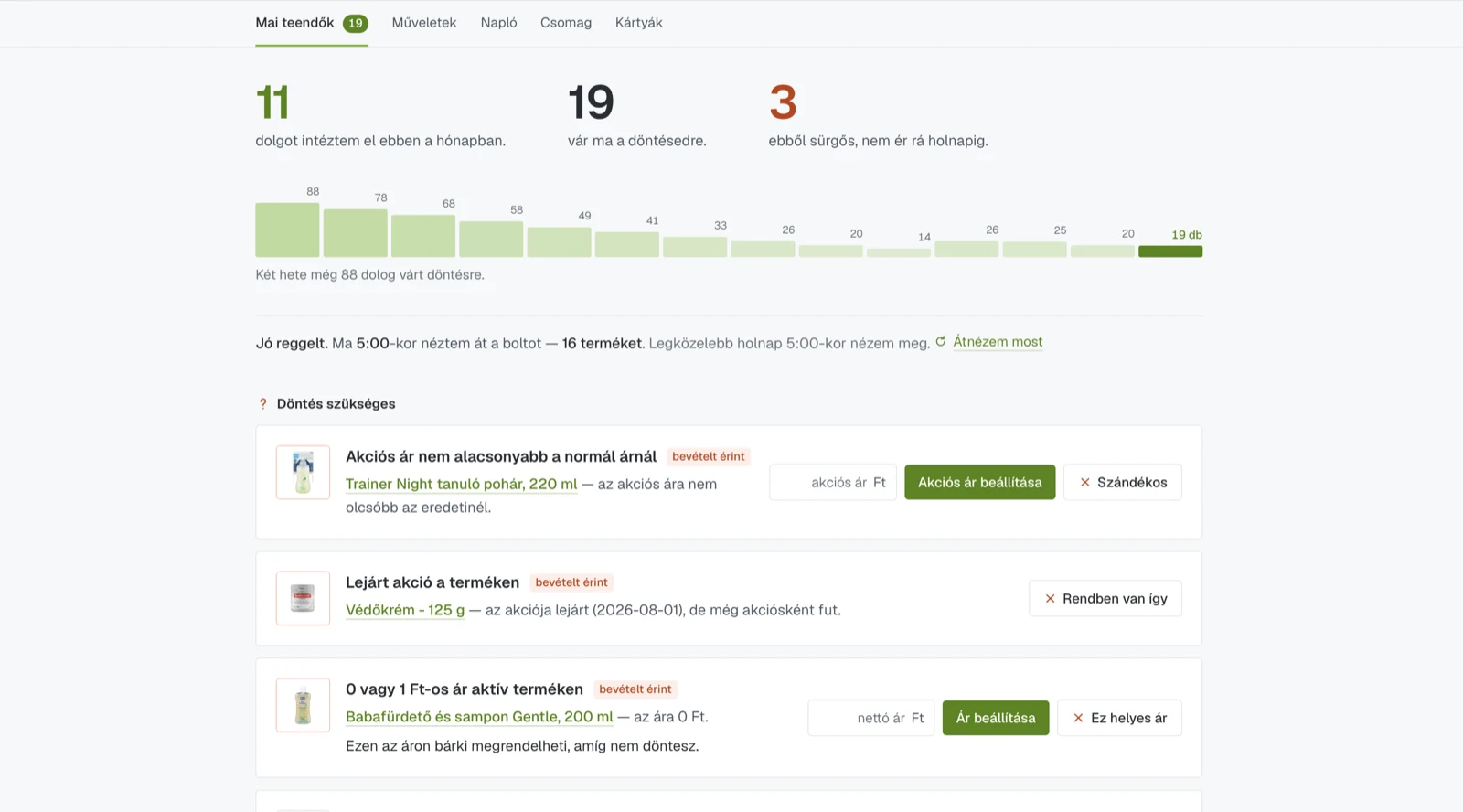
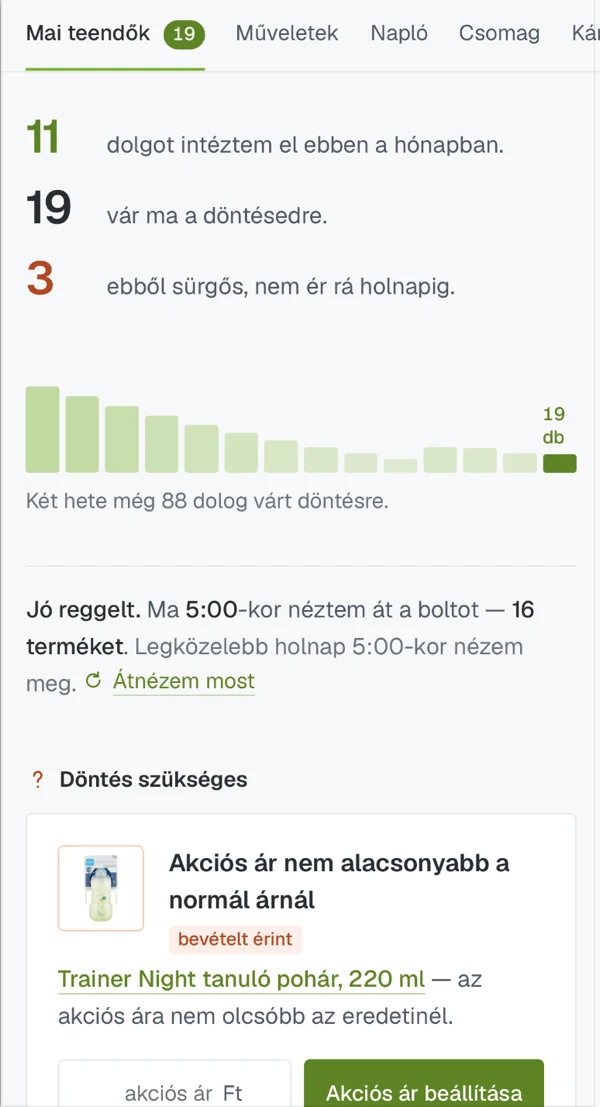
The audience is a merchant with hundreds of live products, where catalog maintenance slipped out of hand long ago. Gondnok runs inside the store's admin, yet the daily touchpoint is the morning email: its buttons work without logging in, because a decision like keep it, deactivate it, or the price is correct should never sit behind a login wall. The app is four tabs: today's items, actions, log, plan. If the merchant starts browsing around in it, the product has failed.
The caretaker metaphor is a design rule. A caretaker walks the round, keeps the place in order, watches over it, and speaks up when something needs the owner's call; it takes care of the place instead of giving advice about it. Every product decision goes through that filter: whatever refuses to fit into a daily email and a decision row is suspect.
The numbers across the top aren't vanity metrics. They say that two weeks ago eighty-eight items were waiting on a decision and today nineteen are. The backlog is the only figure that matters here — and whether it's shrinking.


Write access is the stake
Letting an agent read is easy. Gondnok also writes: it fills in descriptions and search metadata, prepares new products, changes product status — in a store that is live. After the first false positive the merchant switches it off and never switches it back on, so reliability is the value proposition itself.
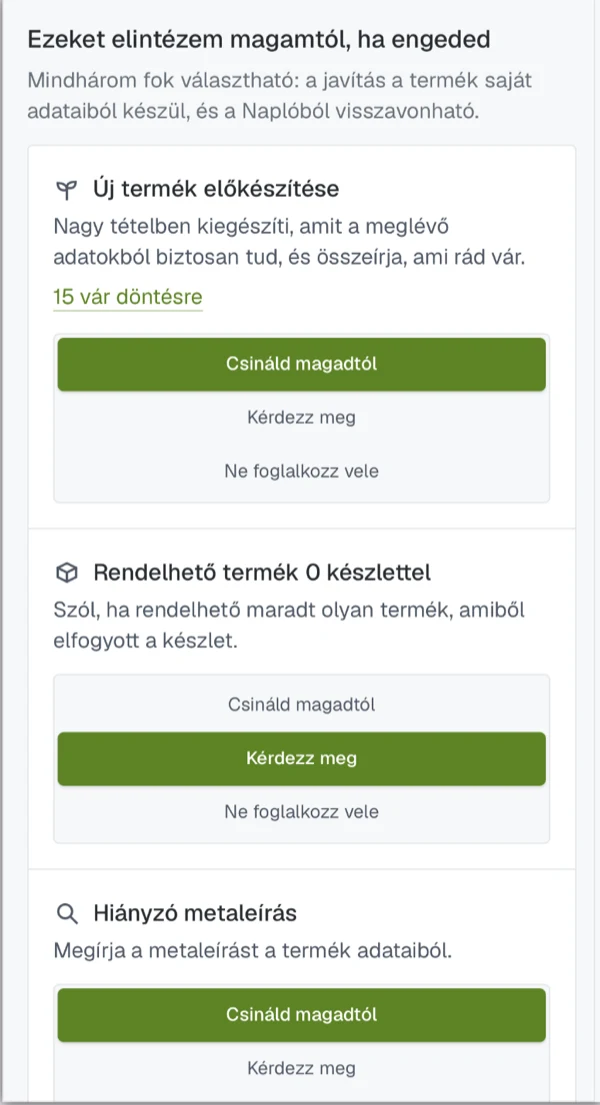
Detection is deterministic: rules decide what counts as a problem. The LLM triages and phrases the findings; it ranks them, explains them in plain language, and gets a judgment call only where a rule cannot reach. Each check runs at its own trust level (do it yourself, ask me first, leave it alone), so the merchant grants trust check by check, as the system earns it.
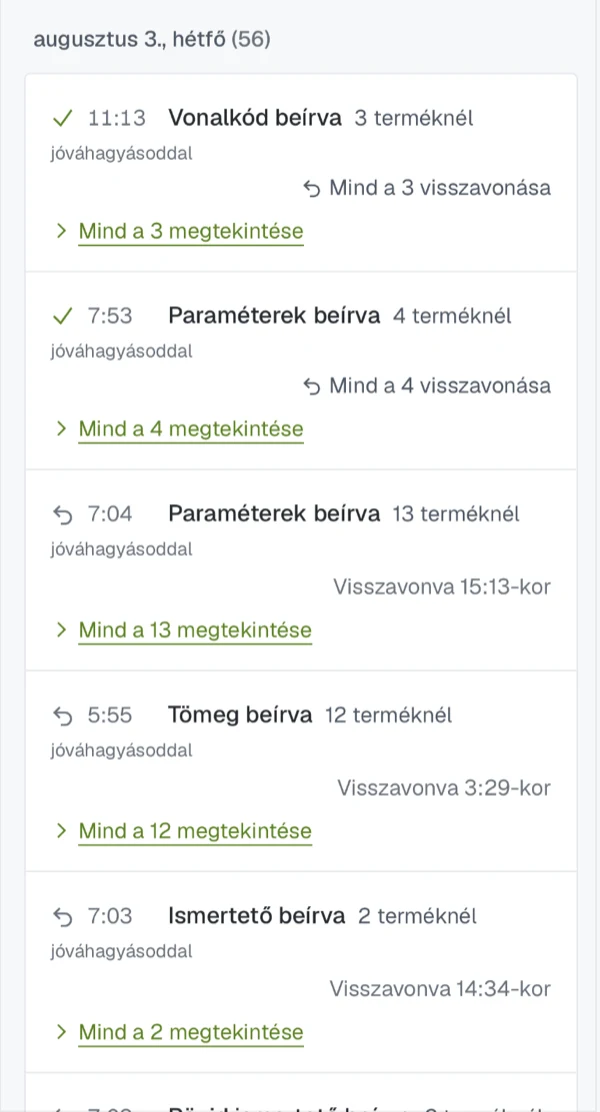
Every write is reversible. Gondnok saves the previous state before each change, and undo is one click, part of the architecture from day one. An agent that touches your store in your name cannot settle for promising to be careful; it has to put anything back.
The trust ladder and the log are two halves of the same principle: the merchant grants permission check by check, and every change shows the previous value and whether Gondnok acted on its own or with approval. Undo has no time limit.
It reports forints
Gondnok reports amounts, not error counts: a suspiciously cheap product took two orders yesterday, and this much revenue is touched; this much is being lost on best-sellers that ran out of stock. The weekly report is quantified the same way: what it handled, what it prevented, what needed the merchant's call. The agent's work reads like a settlement, the one genre a business owner reads anyway.
Hygiene, guard, growth
The daily run works in three layers, and all three together are the product — any one of them alone would be thin. Catalog upkeep maintains the store: filling in missing search titles, descriptions and image captions, flagging wrong prices, expired sales, and live products with no image or category. The guard protects revenue: a suspiciously cheap order immediately, mass price and stock changes, stock-out forecasting, stuck inventory, stalled orders, weekly competitor price watch, dead product pages, unusual return rates, sales that have been running for months. New-product preparation works ahead: it fills in what the existing data determines, drafts suggestions for the missing copy, and hands back a tidy list of what needs an outside source.
All three feed the same dawn round and end in the same single email. That's the point: the merchant gets a caretaker, not three systems.
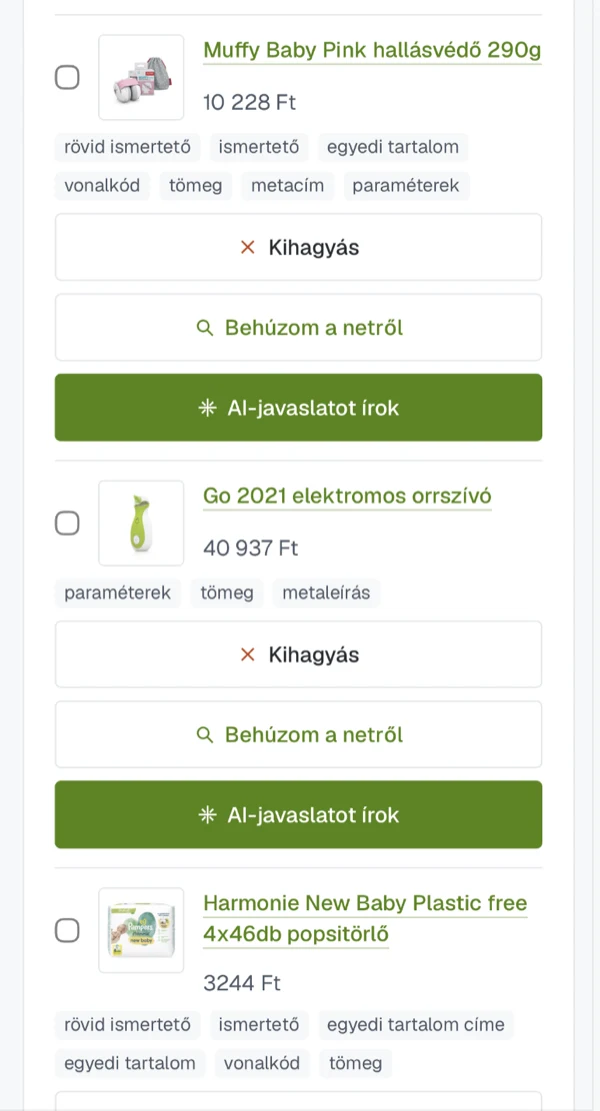
New products are where the boundary is easiest to see. The missing fields sit under each product as labels, and there are three routes: skip it, look it up on the web with verifiable sources, or have the AI draft it. Gondnok decides none of them on its own — a suggestion stays a suggestion until the merchant approves it.

Paper, ink, pine green
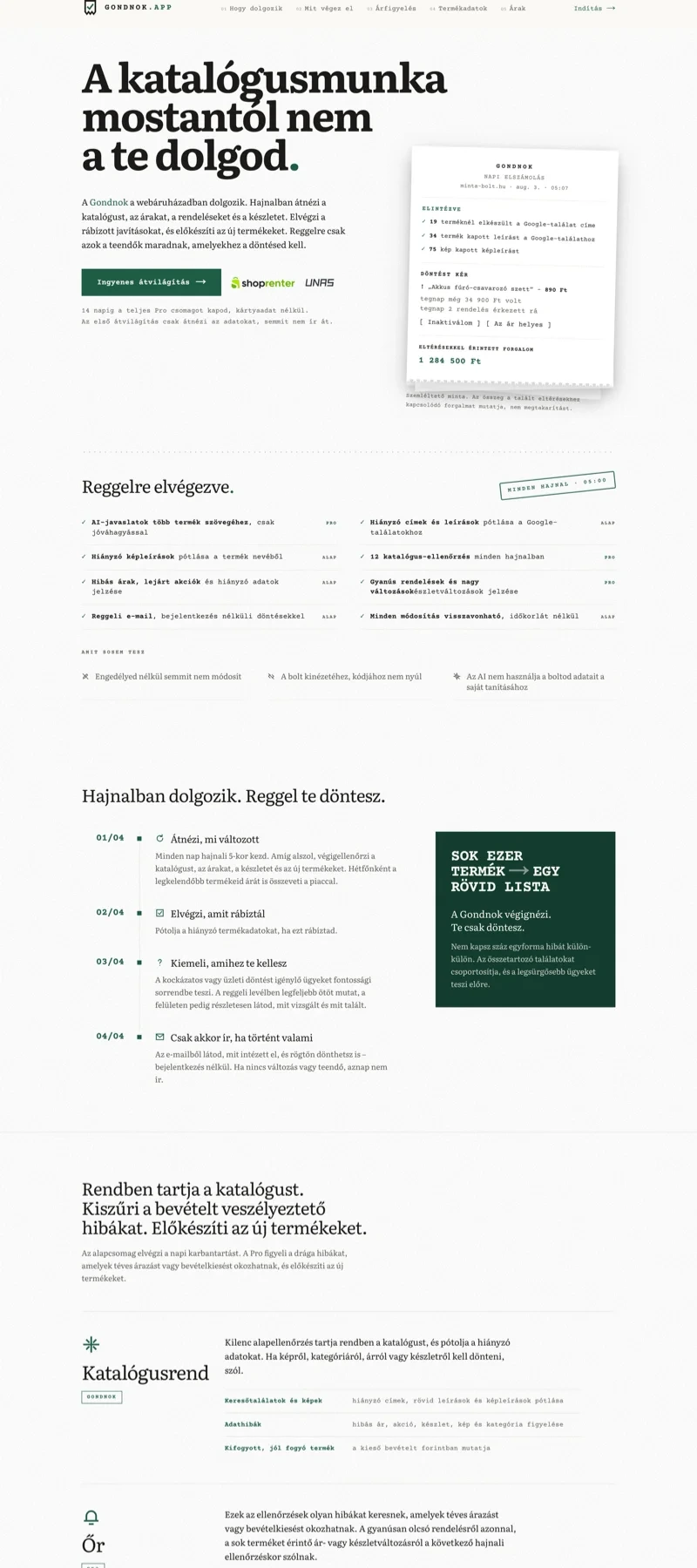
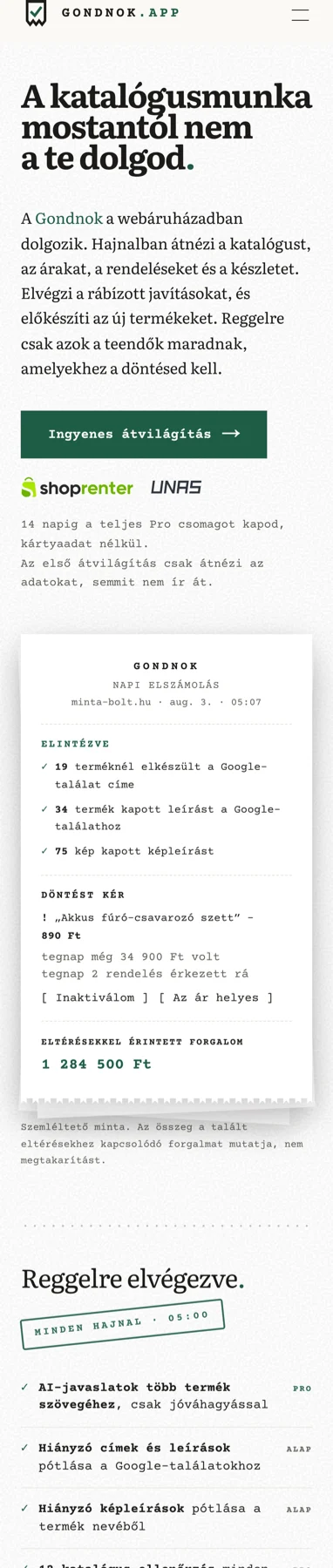
The usual AI visual language of gradients, glow and magic would tell the wrong story here. Gondnok's surface is paper and ink with one pine green, and the centerpiece of the landing page is a daily settlement printing itself out: items handled, one row asking for a decision. It looks like what the product does every morning.
Before the pilot
Gondnok stands before its pilot. The write tests and the undo path are proven on a test store; the entry point is a free audit that only reads (it reviews the store and changes nothing), followed by a fourteen-day full trial with no card required. I measure success on a single bar: does the merchant still have it switched on after two weeks? If yes, Gondnok does what its name promises.
There's always a next level.
If you like what you see (whether you're building a product or a team) I'd love to hear about it.